Showing posts with label Greek Mythology; Primordial Deities. Show all posts

Monday, March 11, 2013

Gaia

Gaia, Mother Earth, the primordial goddess of the earth and grandmother of the gods. She plays the largest role of all the primordial gods in myth. Gaia was born for Chaos, along with her sisters Nyx and Ananke and brothers Chronos, Tartarus, Erebus and Aether. She alone created several beings. The monstrous dragon Python as well as the nymphs known as the Ourea. But most importantly, she created Ouranos and Pontus. With Pontus, she gave birth to the sea gods and goddesses Keto, Phorcys, Eurybia, Nereus and Thaumas. With Aether, she gave birth to the goddess Aergia. But it was her children with Ouranos who are the most well known. By Ouranos, she gave birth to first three Cyclopes (Brontes, Steropes and Arges) and the three Hundred-Handed Ones (Cottus, Briareos and Gyges). Fearing they would overthrow him, Ouranos threw them into the depths of Tartarus, much to Gaia's dismay. However, he didn't imprison their twelve most powerful children, the Titans. Gaia, to free her children and prevent other children from being born of her union with Ouranos, ordered her son Kronos to wait with a scythe. When Ouranos came down to the earth, Kronos ambushed him and castrated his father. From the blood shed on the ground rose the Gigantes (Giants), Erinyes (Furies) and the Meliae (Ash Tree Nymphs). From his genitals thrown into the sea rose Aphrodite. Castrated and humiliated, Ouranos never again came down to earth, but cursed his son that his child would betray him, just as Kronos had betrayed his father. Kronos took control as the King of the Gods and ruled with his brothers and sisters on Mount Othrys. He then imprisoned the Cyclopes and Hundred-Handed Ones in Tartarus once again, and Gaia prophecised that he would indeed be overthrown by his child as Ouranos had said. Gaia later had other children. With Posiedon, she mothered Antaeus and Charybdis. And with Tartarus she had Typhon who would one day seek to overthrow the gods.

Image: Sadness of Gaia by Josephine Wall


I'll write more about the other Primordial Gods later. But next, I'll be writing about the 12 Titans.

Saturday, March 9, 2013

Nyx

Nyx is the primordial goddess of night. Known as Nox to the Romans, she was the wife of Erebus and mother of Hemera, Hypnos, Thanatos, Geras, Styx and the Hesperides. While her portrayals in myth are sparce, she is shown to be a powerful and beautiful goddess.

In one myth, after Hypnos put Zeus to sleep by Hera's orders, Zeus was furious. Hypnos, fearing Zeus's rath, fleed to his mother's side, and even Zeus feared Nyx's anger, so he gave up his pursuit of Hypnos.

Image: La Nuit by William-Adolphe Bouguereau


Erebus

Erebus is the god of darkness, rising from Chaos along with his wife Nyx. Erebus is needless to say a shadowy and mysterious figure who plays little role in mythology. He is the father of many important gods however. With Nyx, he fathered Hemera (Day), Hypnos (Sleep), Thanatos (Death), Geras (Old Age), Styx (River Styx) as well as the Hesperides.

note: there aren't any ancient depictions of Erebus as far as I can find, so I used an image by...

lordaphaius28


Aether

Aether is the god of the upper air, the aether, that makes up the heavens. Aether (also known as akasha or spirit) is the fifth element of western alchemy, and it is the god Aether who gives it his name. Its hard to tell exactly who his parents are. Some insist he is the child of Nyx and Erebus, others that he rose from Chaos like Gaia, Ananke and Tartarus. His origin aside, he plays little role in mythology.


Tartarus

Tartarus
Tartarus is the primordial Greek god who rules the infamous pit of the same name. The pit of Tartarus in the depths of the Underworld was used as a prison by the primordial gods, then the titans and then by the olympian gods. Tartarus has had many inhabitants over the years. Ouranos imprisoned the Hundred-Handed Ones, the Cyclopes and the Titans, in fear that they would betray him. Later, after freeing them, Kronos again imprisoned the Hundred-Handed Ones and Cyclopes. And Later, after again freeing the Hundred-Handed Ones and Cyclopes, Zeus imprisoned many of the Titans and their allies. Few mortals reside their, only those who do things dispicable and unforgivable. Sisyphus, Tantalus and Ixion being a few of these mortal residents. Tartarus himself plays little role in myth, but the pit that he rules is mentioned constantly.


Friday, March 8, 2013

Chronos

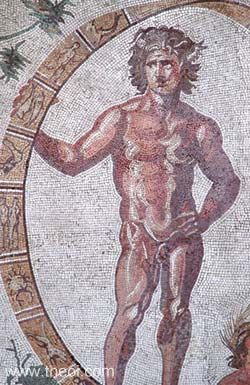
Chronos is the Greek god of time. While often confused with Kronos, the two are very distinct beings, but this confusion lead to the idea of Father Time holding a scythe. In truth, Chronos is very different from Kronos. Not only does he not weild a scythe, but he often takes the form of a serpentine man with three heads (one of a man, one of a bull and one of a lion. However he also appears as the Father Time we'd all recognize; a wise old man with a long grey beard and other times as a young man turning the wheel of the zodiac. Like Ananke, he's of great importance, yet plays little role in myths.


Ananke

Ananke is the Greek goddess of destiny, necessity and fate. She is the all powerful dictator of fate and not only mortals, but even the gods, feared and respected her and paid her homage. As the mother of the fates, she is only one who has control over their decisions. She rarely makes direct appearances in myths, yet she is nevertheless a powerful and important goddess in Greek mythology.


Thursday, March 7, 2013

The Primordial Gods: Part 1

The Primordial Gods of Ancient Greece were the first deities, the ancestors of all the Gods. From Chaos arose Ananke, Chronos, Gaia, Tartarus, Aether, Erebus and Nyx.

Ananke is the goddess of fate and Chronos, her consort, the god of time. Tartarus was the god who ruled the infamous pit of the same name in the depths of the underworld. Aether was the god of the upper air, the fifth element. Erebus was the embodiment of darkness and his consort, Nyx, the goddess of night.

But perhaps the most important of the primordial gods was Gaia, goddess of the earth. Alone, she created Pontus, god of the world ocean, and Ouranos, god of the sky. Ouranos become her husband and had their children, the Hundred-Handed Ones, the Cyclopes and the Titans, and well the rest is history. Gaia and Ouranos are the grandparents of the Olympian gods and they and the primordial gods were always feared and respected by the other gods.

I'll give more information on each of the primordial gods in their own posts.